Welcome to the world of Robert Burns. 558 pieces of writing over a couple of decades, around 400,000 words in total.
Not all of it in Scots. Some of it, as his “Grace Before Dinner” illustrates, in English;
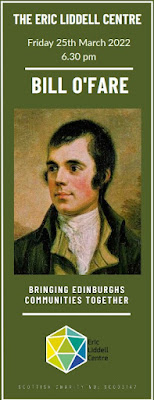
Thank you indeed to those who tonight did provide.
Some of Burns’ writings, recorded for us long-standing folk songs.
An educated man who studied French, Latin and mathematics.
Not a rich man, not a poor man; when he died he left the equivalent in today’s money about £40,000.
And a man known to this day as a father whose children had many mothers.
Every woman in Edinburgh and many beyond seemed to want to explore what he kept in his trousers.
Indeed on the very day of his funeral, his last child was born.
Burns' “Epitaph for James Smith” might equally have applied to him:
The Edinburgh Burns arrived in on 29th November 1786 was different from that we see today. But although Baxter’s Close where he first stayed has gone, were he to stand at the point on the upper Lawnmarket where its entrance was and looked left and right, it might look surprisingly familiar.
Up the hill it would be 1929 before my great-uncle Alexander Stevenson, then Lord Provost, unveiled statues of William Wallace and Robert the Bruce at the Castle entrance. Incidentally, he was a lay preacher at Bruntsfield Church.
If he walked down the hill he would pass the cathedral where 150 years earlier Jenny Geddes threw her stool at the minister in protest against the 1637 Book of Common Prayer’s being used.
And pass the heart of midlothian where the gallows stood at the entrance to the tollbooth first established there in the 1300s.
A distant relative of my youngest nephew’s spouse was held there between August and November 1830 before being transported to Australia after being found guilty of breaking into a house at the bottom of Leith Walk.
When we walk the streets we can, as Burns would have, read the history of the place and its people, from the very stones.
And towards the bottom of the Canongate is the Kirk where the poet Robert Fergusson is buried near economist Adam Smith.
Fergusson used the Scots six-line stanza that Burns adopted for about 50 of his poems.
For my former profession as a politician, his “Braid Claith” applies to me and to all my colleagues;
You can hear the symmetry to Fergusson in Burns’ “Address to the Toothache”;
A particularly ironic poem because it is thought that it was a tooth extraction in winter 1795 that led to a streptococcal infection that killed him early the next year.
There is an overlap between English and Scots – shared grammatical structure, some shared vocabulary, but clear and distinct words drawn from the human experiences of folk in multiple communities.
English is the greatest gift made by any people, in that haphazard way so particularly and endearingly English, to the world. It is not a static instrument of expression.
It is dynamic, some bits borne from day to day, other parts discarded without conscious thought.
Sometimes words re-crafted from the old, sometimes rescued from a linguistic dustbin.
Writers, but most especially those using a poetic form with their necessary focus on the contribution of every single syllable, every single word and its relationship to its neighbours, lead the way in nurturing our tongues – Scots and English.
And in Burns’ poetry, there is something for almost every occasion.
 Tonight we honour Burns and Eric Liddell. Eric would probably not have looked at “An Address to the Deil” for an encomium but one verse suits him just fine;
Shakespeare may have contributed 1,700 words to our modern everyday speech. Examples that we might hear or use regularly include:
“The Dictionary of the Older Scottish Tongue” – (my cousin James Stevenson was editor of many of its volumes) - is a fine complement to my favourite book – the only one I used to read on my occasional visits to the University of Aberdeen’s Library when a student – the Oxford Dictionary.
A book of 600,000 words.
More words than written by Burns in his short lifetime.
Notoriously difficult to be certain, as Burns was nearly as casual with them as he was with his parenting.
My name is Stewart, spelt the Scots way, the tinker family way, with a “W”.
So like Burns, I am no friend of the Hanoverians. He wrote about them on the window of an inn in Stirling, not imagining he was contributing to his literary inheritance;
Now it may not have been wise to append his name as author and take the credit only a few years after the ‘45. But he did.
And maybe today he would even stand for a selfie – as so many tourists, probably unknowing the name or works of the poet – with Robert Fergusson, now memorialised by a beautiful wee statue on the pavement outside.
Language continues its evolution.
And our knowledge of it can keep expanding.
I love to add words to my personal vocabulary. And I shall never run out of words to add.
In Bill Bryden's book, “The Road to Little Dribbling” on page 106, I met the word “bosky” for the first time.
Apparently, it means “covered by trees or bushes”. It’s taken a while to reach me – its origins are in England in the 1500s.
And a Professor with an interest in marine ecology gave me “nurdle”.
It is a small pellet of plastic that is being ingested by marine animals to the risk of its lives.
Previously it was perhaps a run in cricket gained when the ball struck only a glancing blow of an immobile bat.
Burns didn't just pick up and clean up fragments of poetry, of verse he heard across Scotland.
He genuinely added an enormous amount to our literary canon.
He was not just an observer of royal politics, he observed the changing world around him.
After a visit to Carron Iron Works he wrote;
He was an observer of nature, a ploughman close to the earth who wrote of turning over a mouse's home including the famous verse;
Even the monoglot Anglophone can recognise and comprehend, perhaps even quote, two lines;
And relevant today here it is for you Mr Putin. It translates neatly into Russian;
Statistics and rationality argue against blind chance constructing Burns' words.
He was a product of the enlightenment.
Whatever Burns was, and many an academic ekes out a living e'en today in the search for an answer, he was one of us.
Not just the “us” that was Scotland then, nor Scotland now, but worldwide humanity for whom his insights resonate to this day.
A genius who captured the thoughts within we common folk, elevated it through prose, song and poem to levels unachievable by us lesser mortals.
We would not necessarily want to be everything that Burns was – gauger, philander, philosopher, wordsmith.
He is not in the exclusive ownership of the rich and privileged.
Long before Doctor Who – an act of fiction – Robert Burns invented time travel and journies with us yet.
And the journey's not yet o'er.
He was a five-foot tall colossus among the self-selected unco guid of Edinburgh.
His immortality was bought hard and early.
Death collected him after only 37 years.
Not all of it in Scots. Some of it, as his “Grace Before Dinner” illustrates, in English;

O thou who kindly dost provide
For every creature's want!
We bless Thee, God of Nature wide,
For all Thy goodness lent:
And if it please Thee, Heavenly Guide,
May never worse be sent;
But, whether granted, or denied,
Lord, bless us with content. Amen!
For every creature's want!
We bless Thee, God of Nature wide,
For all Thy goodness lent:
And if it please Thee, Heavenly Guide,
May never worse be sent;
But, whether granted, or denied,
Lord, bless us with content. Amen!
Thank you indeed to those who tonight did provide.
Some of Burns’ writings, recorded for us long-standing folk songs.
An educated man who studied French, Latin and mathematics.
Not a rich man, not a poor man; when he died he left the equivalent in today’s money about £40,000.
And a man known to this day as a father whose children had many mothers.
Every woman in Edinburgh and many beyond seemed to want to explore what he kept in his trousers.
Indeed on the very day of his funeral, his last child was born.
Burns' “Epitaph for James Smith” might equally have applied to him:
Lament him, Mauchline husbands a’,
He aften did assit ye;
For had ye staid hale weeks awa,
Your wives they ne’er had miss’d ye.
Ye Mauchline bairns, as on ye press
To school in bands thegither,
O tread ye lightly on his grass,
Perhaps he was your father!
He aften did assit ye;
For had ye staid hale weeks awa,
Your wives they ne’er had miss’d ye.
Ye Mauchline bairns, as on ye press
To school in bands thegither,
O tread ye lightly on his grass,
Perhaps he was your father!
The Edinburgh Burns arrived in on 29th November 1786 was different from that we see today. But although Baxter’s Close where he first stayed has gone, were he to stand at the point on the upper Lawnmarket where its entrance was and looked left and right, it might look surprisingly familiar.
Up the hill it would be 1929 before my great-uncle Alexander Stevenson, then Lord Provost, unveiled statues of William Wallace and Robert the Bruce at the Castle entrance. Incidentally, he was a lay preacher at Bruntsfield Church.
If he walked down the hill he would pass the cathedral where 150 years earlier Jenny Geddes threw her stool at the minister in protest against the 1637 Book of Common Prayer’s being used.
And pass the heart of midlothian where the gallows stood at the entrance to the tollbooth first established there in the 1300s.
A distant relative of my youngest nephew’s spouse was held there between August and November 1830 before being transported to Australia after being found guilty of breaking into a house at the bottom of Leith Walk.
When we walk the streets we can, as Burns would have, read the history of the place and its people, from the very stones.
And towards the bottom of the Canongate is the Kirk where the poet Robert Fergusson is buried near economist Adam Smith.
Fergusson used the Scots six-line stanza that Burns adopted for about 50 of his poems.
For my former profession as a politician, his “Braid Claith” applies to me and to all my colleagues;
Ye wha are fain to hae your name
Wrote in the bonny book of fame,
Let merit nae pretension claim
Wrote in the bonny book of fame,
Let merit nae pretension claim
To laurel'd wreath,
But hap ye weel, baith back and wame,
But hap ye weel, baith back and wame,
In gude Braid Claith.
You can hear the symmetry to Fergusson in Burns’ “Address to the Toothache”;
Where'er that place be, priests ca' hell,
Where a' the tones o' misery yell,
An' ranked plagues their numbers tell,
In dreadfu' raw,
Thou, Toothache, surely bear'st the bell,
Amang them a'!
Where a' the tones o' misery yell,
An' ranked plagues their numbers tell,
In dreadfu' raw,
Thou, Toothache, surely bear'st the bell,
Amang them a'!
A particularly ironic poem because it is thought that it was a tooth extraction in winter 1795 that led to a streptococcal infection that killed him early the next year.
There is an overlap between English and Scots – shared grammatical structure, some shared vocabulary, but clear and distinct words drawn from the human experiences of folk in multiple communities.
English is the greatest gift made by any people, in that haphazard way so particularly and endearingly English, to the world. It is not a static instrument of expression.
It is dynamic, some bits borne from day to day, other parts discarded without conscious thought.
Sometimes words re-crafted from the old, sometimes rescued from a linguistic dustbin.
Writers, but most especially those using a poetic form with their necessary focus on the contribution of every single syllable, every single word and its relationship to its neighbours, lead the way in nurturing our tongues – Scots and English.
And in Burns’ poetry, there is something for almost every occasion.
Great is thy power, an’ great thy fame;
Far kend an’ noted is thy name;
An’ tho yon lowan heugh’s thy hame,
Thou travels far;
An’ faith! Thou’s neither lag nor lame,
Nor blate nor scaur.
Far kend an’ noted is thy name;
An’ tho yon lowan heugh’s thy hame,
Thou travels far;
An’ faith! Thou’s neither lag nor lame,
Nor blate nor scaur.
Shakespeare may have contributed 1,700 words to our modern everyday speech. Examples that we might hear or use regularly include:
Barefaced
Madcap
Panders
Worthless
Besmirch
Pedant
Swagger
Madcap
Panders
Worthless
Besmirch
Pedant
Swagger
“The Dictionary of the Older Scottish Tongue” – (my cousin James Stevenson was editor of many of its volumes) - is a fine complement to my favourite book – the only one I used to read on my occasional visits to the University of Aberdeen’s Library when a student – the Oxford Dictionary.
A book of 600,000 words.
More words than written by Burns in his short lifetime.
Notoriously difficult to be certain, as Burns was nearly as casual with them as he was with his parenting.
My name is Stewart, spelt the Scots way, the tinker family way, with a “W”.
So like Burns, I am no friend of the Hanoverians. He wrote about them on the window of an inn in Stirling, not imagining he was contributing to his literary inheritance;
Here Stewarts once in glory reigned,
And laws dor Scotland's weal ordained,
But now unroof'd their palace stands,
[that's Linlithgow Palace by the way]
Their sceptre's sway'd by other hands,
The injured Stewart line is gone,
A race outlandish fills their throne
An idiot race, to honour lost;
Who know them best despise them most!
And laws dor Scotland's weal ordained,
But now unroof'd their palace stands,
[that's Linlithgow Palace by the way]
Their sceptre's sway'd by other hands,
The injured Stewart line is gone,
A race outlandish fills their throne
An idiot race, to honour lost;
Who know them best despise them most!
Now it may not have been wise to append his name as author and take the credit only a few years after the ‘45. But he did.
And maybe today he would even stand for a selfie – as so many tourists, probably unknowing the name or works of the poet – with Robert Fergusson, now memorialised by a beautiful wee statue on the pavement outside.
Language continues its evolution.
And our knowledge of it can keep expanding.
I love to add words to my personal vocabulary. And I shall never run out of words to add.
In Bill Bryden's book, “The Road to Little Dribbling” on page 106, I met the word “bosky” for the first time.
Apparently, it means “covered by trees or bushes”. It’s taken a while to reach me – its origins are in England in the 1500s.
And a Professor with an interest in marine ecology gave me “nurdle”.
It is a small pellet of plastic that is being ingested by marine animals to the risk of its lives.
Previously it was perhaps a run in cricket gained when the ball struck only a glancing blow of an immobile bat.
Burns didn't just pick up and clean up fragments of poetry, of verse he heard across Scotland.
He genuinely added an enormous amount to our literary canon.
He was not just an observer of royal politics, he observed the changing world around him.
After a visit to Carron Iron Works he wrote;
We cam na here to view your warks,
In hopes to be mair wise,
But only, lest we gang to hell,
It may be nae surprise.
In hopes to be mair wise,
But only, lest we gang to hell,
It may be nae surprise.
He was an observer of nature, a ploughman close to the earth who wrote of turning over a mouse's home including the famous verse;
But, Mousie, thou art no thy lane,
In proving foresight may be vain;
The best-laid schemes o' mice an' men
Gang aft agley,
An'lea'e us nought but grief an' pain,
For promis'd joy!
In proving foresight may be vain;
The best-laid schemes o' mice an' men
Gang aft agley,
An'lea'e us nought but grief an' pain,
For promis'd joy!
Even the monoglot Anglophone can recognise and comprehend, perhaps even quote, two lines;
The best-laid schemes o' mice an' men
Gang aft agley,
Gang aft agley,
And relevant today here it is for you Mr Putin. It translates neatly into Russian;
Лучшие схемы мышей и мужчин
Банда на корме Эгли,
Банда на корме Эгли,
He was a product of the enlightenment.
Whatever Burns was, and many an academic ekes out a living e'en today in the search for an answer, he was one of us.
Not just the “us” that was Scotland then, nor Scotland now, but worldwide humanity for whom his insights resonate to this day.
A genius who captured the thoughts within we common folk, elevated it through prose, song and poem to levels unachievable by us lesser mortals.
We would not necessarily want to be everything that Burns was – gauger, philander, philosopher, wordsmith.
He is not in the exclusive ownership of the rich and privileged.
Long before Doctor Who – an act of fiction – Robert Burns invented time travel and journies with us yet.
And the journey's not yet o'er.
He was a five-foot tall colossus among the self-selected unco guid of Edinburgh.
His immortality was bought hard and early.
Death collected him after only 37 years.
Fill me with the rosy wine,
Call a toast – a toast divine,
Give the poet's long heard name,
Robert Burn's a' this nicht's game,
Rise now and gies a licht,
Life short, but life immortal,
Tonight's the night he stands in ev'ry portal,
We toast you now anew,
And bid you ne'er adieu,
aye wi' us
Call a toast – a toast divine,
Give the poet's long heard name,
Robert Burn's a' this nicht's game,
Rise now and gies a licht,
Life short, but life immortal,
Tonight's the night he stands in ev'ry portal,
We toast you now anew,
And bid you ne'er adieu,
aye wi' us
Burns, Robert Burns
Comments
Post a Comment
Your comments will be read before adding to the blog.
Abuse, illegality or comment at odds with prevailing medical advice will be excluded.